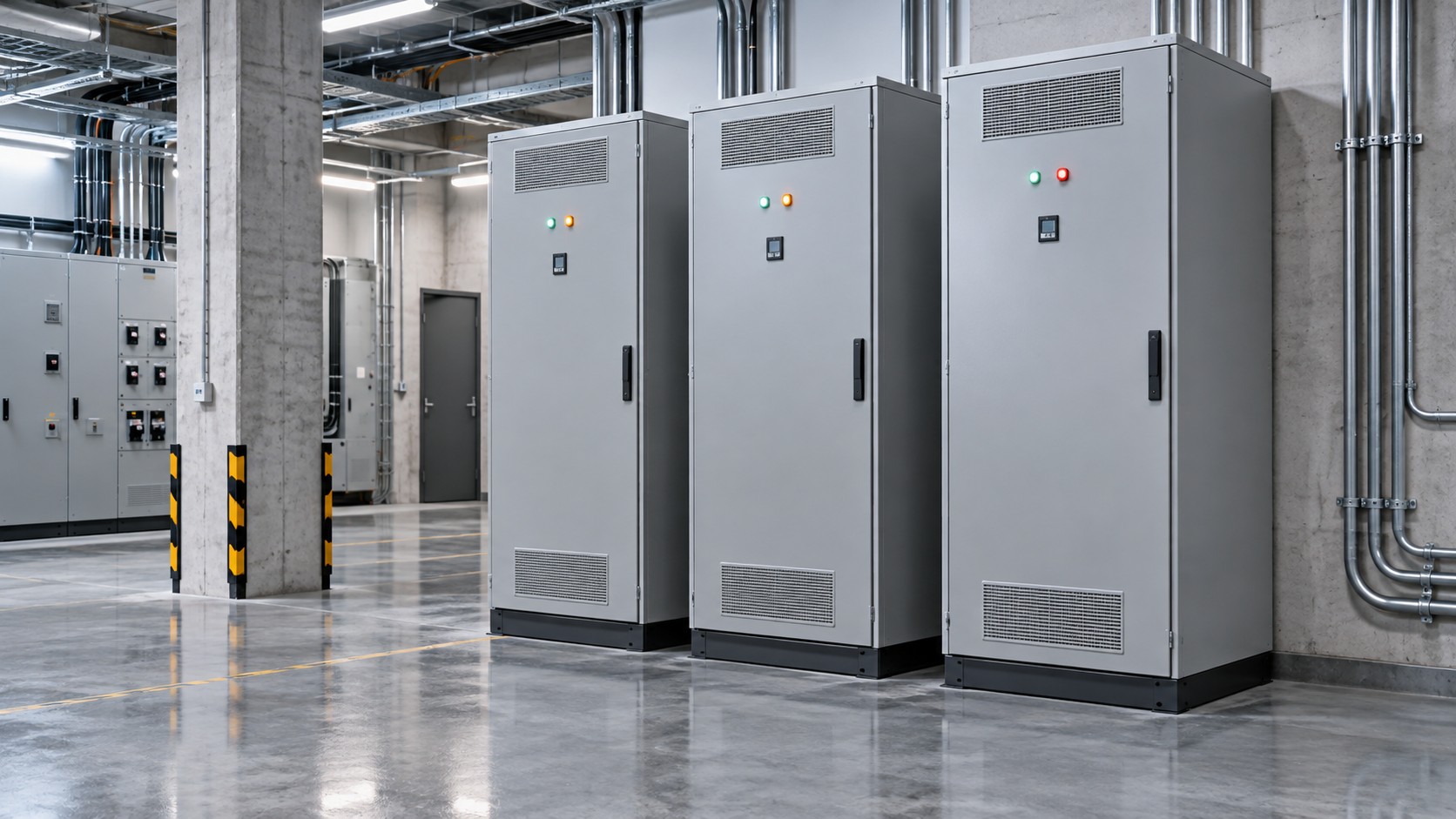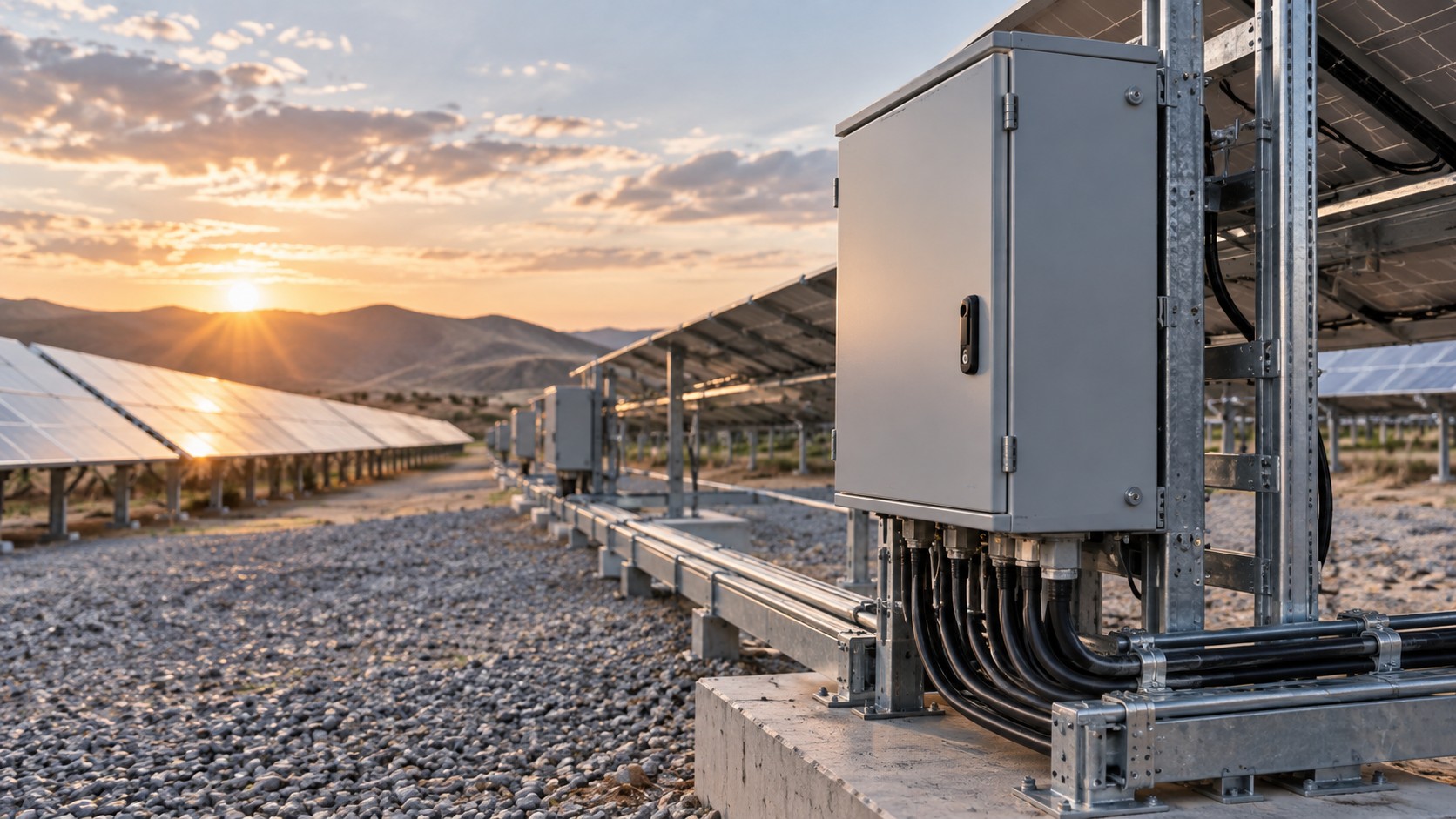
Heat and moisture cause most of the premature failures seen in distribution boards. Every watt dissipated by breakers, terminals, and busbars has to leave the enclosure, and when a humid box cools overnight, condensation forms on the coldest surface. This article gives a practical method for estimating internal temperature, sizing ventilation, and controlling condensation, with the IEC 61439 service conditions and verification clauses that apply.
Why heat matters in a distribution board
Losses inside a board come from protective devices, terminals, busbars, contactors, drives, and any transformers or power supplies. The consequences are well known in reliability engineering: insulation and electronic component ageing accelerate with temperature, and a widely used rule of thumb is that each 10 K increase roughly halves insulation life. Even where the rule is only approximate, the direction is not: a board that runs 20 K hotter will need attention sooner.
Standards treat this through design verification. IEC 61439-1 Clause 10.10 covers verification of temperature-rise limits; IEC 61439-3 adds the particular requirements for distribution boards intended for use by ordinary persons (and GB 7251.3 is the Chinese equivalent used for many domestic projects).
Service conditions and the limits you design to
IEC 61439-1 defines standard service conditions, and ratings are based on them:
- Ambient air temperature: not above +40 °C, with a 24 h average not above +35 °C; lower limit −5 °C.
- Altitude: not above 2000 m. Above that, air density and cooling fall, and derating is required.
- Relative humidity: up to 50 % at +40 °C, higher values permitted at lower temperatures (for example 90 % at +20 °C).
Temperature-rise limits are assigned by part, not as a single number. IEC 61439-1 Table 6 gives separate limits for terminals for external conductors, for external surfaces of the enclosure (metallic versus non-metallic), for manual operating means, and for internal conductors and busbars, the latter depending on material and coating. Values commonly applied in project specifications include 70 K for terminals for external insulated conductors, 30 K for external metallic surfaces and 40 K for non-metallic surfaces, and 15 K for metal manual operating means — but always verify against the current edition of the standard and the project specification before writing them into a contract.
Estimating the internal temperature
For a naturally cooled sheet-steel enclosure, a useful first estimate is:
Q = k × A × ΔT
where Q is the internal heat load in watts, A is the effective cooling area in m² (walls and top, excluding the base and the face mounted against a wall), k is the heat transfer coefficient — around 5 W/(m²·K) is a common working value for painted steel with natural convection — and ΔT is the internal-to-ambient air temperature difference.
Example (illustrative)
- Wall-mounted steel board: 800 × 600 × 250 mm (W × H × D).
- Effective cooling area: front 0.48 m² + top 0.20 m² + two sides 0.30 m² + base 0.20 m² ≈ 1.18 m².
- Internal losses, from device data: 12 outgoing MCCBs plus a 400 A incomer ≈ 120 W.
- ΔT ≈ 120 / (5 × 1.18) ≈ 20 K.
At a 40 °C ambient that puts internal air near 60 °C, with the air at the top of the box hotter still. Since many devices are rated for operation at 40 °C ambient (and many are derated above it), this board needs either more area, lower losses, or forced ventilation. Example only — device losses and enclosure coefficients vary; use manufacturer data and, for critical boards, a temperature-rise test.
Solar gain on outdoor enclosures
Outdoor boxes add a second heat source. Absorbed solar heat ≈ projected sunlit area × irradiance × surface absorptivity. Example: 0.5 m² of projected area, 800 W/m² irradiance, a mid-grey finish with absorptivity around 0.5 → roughly 200 W of additional load, more than the internal losses of a small board. A light finish (for example RAL 7035) or a sunshield is the cheapest control.
Ventilation options compared
| Method | How it works | Typical effect | Effect on IP rating | Use when |
|---|---|---|---|---|
| Natural convection | Heat leaves through the walls | Limited; ΔT set by area and losses | No openings, IP rating preserved | Low losses, sealed or dusty environments |
| Filter fan | Ambient air drawn through a filter | Removes tens to hundreds of watts | Kit is typically IP54; the enclosure rating becomes the lowest rating of its openings | Clean indoor air, ambient below the equipment limit |
| Air-to-air heat exchanger | Internal air loop exchanges heat with outside air, no air exchange | Tens to hundreds of watts | Internal rating maintained | Dusty, humid, or corrosive atmospheres |
| Cabinet air conditioner | Refrigeration circuit | Hundreds to thousands of watts; can cool below ambient | Internal rating maintained | High losses, high ambient, or temperature-sensitive electronics |
| Anti-condensation heater with hygrostat | Keeps internal air a few K above ambient, lowering RH | Small power, tens of watts | No openings required | Humid or rapidly cycling environments |
Sizing a fan from the heat load
Air-based cooling is calculated from the air temperature rise across the enclosure:
Q = ρ × cp × V̇ × ΔT
with ρ ≈ 1.2 kg/m³ and cp ≈ 1005 J/(kg·K) for air, V̇ in m³/s.
Example: removing 120 W with a 5 K air temperature rise needs V̇ = 120 / (1.2 × 1005 × 5) ≈ 0.0199 m³/s ≈ 72 m³/h. Select the next size up and derate for filter fouling and altitude. Example only; use the fan manufacturer’s performance curve at the actual system resistance.
Condensation: the other half of the problem
Condensation forms when any surface is colder than the dew point of the air around it. Using the Magnus approximation:
γ = ln(RH/100) + 17.62 × T / (243.12 + T) and Td = 243.12 × γ / (17.62 − γ)
Example: air at 40 °C and 60 % RH gives a dew point of about 31 °C. A board mounted on an outside wall that cools overnight to 25 °C will therefore wet its internal surfaces. Repeat that cycle daily and corrosion, tracking, and insulation failures follow.
Controls, in order of cost:
- Keep water out: IP55 or IP65 enclosure for outdoor or washdown areas (IEC 60529), cable entries from the bottom only, drip loops, sealed gland plates, and a sloped top.
- Equalise pressure without admitting water: a membrane breather drain lets the box breathe as it heats and cools while maintaining the enclosure rating.
- Heat slightly: an anti-condensation heater (commonly 10 W to 50 W for small boards) controlled by a hygrostat set a few kelvin above ambient. Using the relation above, holding internal air 10 K above a 40 °C ambient in a box with A = 1.18 m² and k = 5 W/(m²·K) needs roughly 60 W; check the actual surface area.
- Break the thermal bridge: stand the board off a cold wall rather than bolting it flat, so the back plate is not the coldest surface in the box.
- Manage air exchange: in humid climates, a sealed board with a breather often performs better than a louvered one that breathes wet air all night.
Application Scenario: Rooftop Distribution Board Feeding Air-Handling Units
Scenario constraints
A wall-mounted board feeds three rooftop air-handling units. Summer ambient on the roof reaches 45 °C with strong direct sun, humidity is high in the monsoon season, and the site is 3 km from the sea. The board must stay sealed against driving rain, so the natural choice of a fan and filter kit is compromised by salt-laden, dusty air.
Selection approach
- Enclosure: IP65 to IEC 60529, impact rating IK09 or IK10 to IEC 62262, marine-grade coating or stainless for the coastal location.
- Solar control: light-coloured finish plus a stand-off sunshield over the sun-facing side; this removes most of the absorbed solar load.
- Losses: select breakers with the lowest practical power loss and leave at least 20 % spare way space so the box is not packed; heat dissipated per unit volume matters as much as total watts.
- Cooling choice: with ambient above the standard 40 °C, forced ventilation brings in hot, salty air — prefer a sealed box with a heat exchanger or, if the load justifies it, a small cabinet air conditioner.
- Moisture: 30–50 W anti-condensation heater on a hygrostat, plus a membrane breather drain at the lowest point.
- Layout: heat-producing devices low, terminals and electronics higher but away from the top plate; keep wiring routes open rather than bundled so air can circulate.
- Mounting: stand off from the parapet wall; cable entries from below with sealed glands.
Common mistakes
- Running a fan and filter kit in a salty or dusty environment; the filter loads and the internals corrode.
- Dark enclosure in direct sun with no shield.
- Heater wired directly, without a hygrostat, so it runs continuously and adds heat the board must then reject.
- Cable entries on the top face or unsealed knockouts, which let rain and humid air in.
- No spare capacity, so the board is filled to rating and runs hot from day one.
- Bolting the back plate flat against an outside wall, making it the condensation surface.
- Forgetting altitude: above 2000 m the air is thinner, so both convection and fan cooling fall and derating applies.
Acceptance checkpoints
- Temperature-rise check under load: thermocouples or a thermographic survey at the hottest terminals, on busbars or distribution blocks, and on the enclosure surface; compare against the applicable IEC 61439 limits.
- Insulation resistance measured before energisation and again after a humid night, with results recorded.
- Heater and hygrostat function test; confirm the set point and that the heater cycles rather than runs continuously.
- Enclosure integrity: gasket compression even around the door, gland plate sealed, breather drain fitted at the lowest point, door closed with a torque-checked latch where specified.
- IP rating evidence for the assembled enclosure and any openings (IEC 60529).
- Thermography repeated after 72 h at design load, before handover.
Selection checklist
- Ambient temperature range, altitude, humidity, and whether the board is indoors, outdoors, or in a washdown area.
- Heat load estimate from device data, with a margin.
- Enclosure size, material, colour, IP rating (IEC 60529), and IK rating (IEC 62262).
- Cooling method: natural, fan, heat exchanger, or air conditioner — matched to the atmosphere and the rating that must be kept.
- Condensation control: sealing, breather, heater and hygrostat, mounting stand-off.
- Internal layout: spacing, ventilation paths, spare ways, and support for heavy cables.
- Derating of devices for ambient temperature and for grouping.
- Monitoring: thermography ports, temperature sensors, or a monitoring device if the board is critical.
Quality inspection checkpoints
- Material and coating: sheet thickness, coating type and thickness, and adhesion checked against the order.
- Construction: door fit and gasket compression, hinge and latch operation, no sharp edges, welds finished.
- Terminals and busbars: correct section for the rating, torque values applied and recorded.
- Rating plate: complete and durable, stating rated current, voltage, frequency, IP, IK, short-circuit rating, and the referenced standard.
- Routine verification per IEC 61439-1 Clause 11, including the dielectric test, with records per unit.
- Where a temperature-rise test was performed: the report should state the arrangement, the test current, ambient conditions, and measured rises.
- Packaging: door protected, internal components secured, moisture protection for sea freight.
How to evaluate a supplier
- Ask for temperature-rise verification: tested to IEC 61439-1 Clause 10.10, or declared by comparison with a reference design under the standard’s rules.
- Ask for device loss data used in the calculation, not a generic statement.
- Ask how the enclosure rating is maintained with any openings: fan kits, breathers, and glands.
- Ask for coating specification and test evidence for coastal or chemical environments.
- Ask about customisation: sunshields, heater and hygrostat wiring, stand-off brackets, and monitoring options.
- Ask for the routine verification procedure and what records ship with each board.
Frequently Asked Questions
1. How hot is too hot inside a distribution board?
Compare measured rises against the IEC 61439-1 Table 6 limits for the specific part — terminals, external surfaces, operating handles, and internal conductors each have their own value. Also check the device manufacturer’s ambient rating, since most protective devices are rated for operation at 40 °C ambient and are derated above it.
2. Can I just add a fan and filter kit?
Only if the surrounding air is cleaner and cooler than the limit you are trying to hold, and only if the reduced ingress protection is acceptable. The enclosure rating becomes the lowest rating of its openings.
3. What size anti-condensation heater do I need?
Small boards commonly use 10–50 W. Size it from the enclosure surface area and the temperature rise you want to hold: Q ≈ k × A × ΔT, with k around 5 W/(m²·K) for painted steel. Use a hygrostat so it runs only when needed.
4. Does a sealed enclosure still get condensation?
Yes, if humid air is trapped inside and a surface drops below the dew point. Sealing, a breather drain, and a heated, controlled internal environment address the cause; sealing alone does not.
5. How much does enclosure colour matter outdoors?
Materially. Absorptivity drives absorbed solar heat; a light finish or a sunshield can remove a load larger than the internal losses of a small board.
6. Do I need to derate for altitude?
Above 2000 m, yes — IEC 61439-1 service conditions assume 2000 m or less, and thinner air reduces both convection and forced-air cooling. Apply the manufacturer’s derating factors.
7. How should I verify the result on site?
Thermography or thermocouple measurement at design load, after a stabilisation period, comparing the hottest points against the applicable limits. Repeat after a humid night and check insulation resistance.
Designing a Board That Runs Cool and Dry?
BANGE Electric supplies distribution boards and enclosures with declared ratings, coating options for coastal and industrial environments, and accessory options such as heaters, hygrostats, breathers, and sunshields. Send your load list, ambient conditions, and enclosure requirements through the distribution boxes page or contact our engineering team.
Requirements may vary by application, market, and applicable standard.