A hygienic cable tray is one that can be cleaned to the plant’s hygiene standard without holding water, product residue, or bacteria. In practice that means 316L stainless (not 304, not galvanised), continuously welded and ground-smooth joints, a surface finish around Ra 0.8 µm or better, open construction that drains, and enough clearance from walls and ceilings to clean behind. This article covers material choice, finish, washdown ratings, and a bottling-hall case.
What makes a cable tray hygienic
Four properties decide whether a tray can survive a washdown regime:
- Cleanability — no crevices, no dead legs, no horizontal ledges where soil collects; welds continuous and ground flush.
- Drainability — water and detergent must leave, not pool. Open mesh and perforated construction drains; solid-bottom tray does not unless drain holes are provided.
- Chemical resistance — the alloy must resist the actual cleaning chemicals: caustic (typically pH 12–14), acidic descalers, and sanitisers such as peracetic acid or hypochlorite.
- Accessible geometry — clearance from walls, ceilings, and equipment so cleaning tools reach all surfaces.
The reference documents used in this sector include EHEDG (European Hygienic Engineering & Design Group) guidance, 3-A Sanitary Standards in North America, ISO 14159 (hygiene requirements for the design of machinery), and EN 1672-2 (food processing machinery — hygiene requirements). The mechanical performance of the tray itself is still governed by cable tray standards: IEC 61537 (cable tray systems) and NEMA VE 1 (metallic cable tray systems) in North America.
Material selection: 304L, 316L, duplex or FRP
Pitting resistance is summarised by the pitting resistance equivalent number:
PREN = %Cr + 3.3 × %Mo + 16 × %N
| Material | Typical Cr / Mo / N | PREN (approx.) | Suitability in washdown zones |
|---|---|---|---|
| AISI 304L | 18 % / 0 % / 0.1 % | ≈ 19–20 | Dry or low-care areas only; chloride cleaners cause pitting |
| AISI 316L | 17 % / 2.1 % / 0.1 % | ≈ 24–27 | Standard choice for food and beverage washdown areas |
| Duplex 2205 | 22 % / 3.2 % / 0.17 % | ≈ 35 | High-chloride, high-temperature, or aggressive chemical areas |
| FRP / GRP (isophthalic or vinyl ester) | n/a | n/a | Corrosion-resistant, but check cleanability, surface stability, fire and smoke classification |
| Hot-dip galvanised steel | n/a | n/a | Not suitable inside washdown zones — zinc is attacked by both acid and caustic cleaners |
Example values for guidance; confirm actual composition against the mill certificate.
Two practical rules follow from this table. First, specify the low-carbon “L” grades (304L / 316L, carbon ≤ 0.03 %) so that welding does not sensitise the heat-affected zone. Second, match the fasteners to the tray: use A4-70 or A4-80 stainless bolts (A4 = 316 family, 70/80 = tensile strength class) on 316L tray, and avoid mixing 304 and 316 components in a wet zone.
Surface finish, welds and geometry
- Roughness: hygienic design guidance commonly specifies Ra ≤ 0.8 µm for surfaces in the product area; electropolishing typically achieves Ra in the 0.3–0.6 µm range. Confirm the value required by the plant’s hygiene standard.
- Welds: continuous, fully penetrated, and ground flush. Tack welds, skip welds, and unground fillets leave crevices that harbour soil and resist cleaning.
- Corners: internal radii large enough to be cleaned; avoid sharp internal corners.
- Open construction: wire mesh or perforated tray sheds water and cleaning foam and dries quickly. Where a solid-bottom or covered section is needed, provide drainage and a removable, sealed cover.
- Clearance: leave a stand-off from walls and soffits so a brush or spray reaches behind the run — typically 50–100 mm in practice, larger where the cleaning method requires it.
- Accessories: bolt-on dividers and clamps create crevices. Where separation is needed, prefer integral dividers formed in the tray or welded and ground smooth.
Tray types in hygienic service
- Wire mesh tray — best drainage and visibility, easy to inspect, good for lightly loaded control and instrumentation runs; check load rating because light-duty mesh deflects.
- Perforated tray — drains through the perforations, better cable support than mesh; the usual default for mixed power and control in food plants.
- Ladder tray — for heavy power cables; rungs shed water, but cable sag between rungs can trap dirt — keep rung spacing small and support power cables properly.
- Solid-bottom / covered trunking — only where splash protection is required, and then with sealed covers, drainage, and an IP rating appropriate to the washdown method.
Washdown ratings: what IP66 and IP69 mean here
Degrees of protection are defined by IEC 60529 for enclosures; the high-pressure, high-temperature washdown code (IP69 / IP69K) comes from ISO 20653 and DIN 40050-9. Typical test parameters for IP69K are water at about 80 °C, 80–100 bar, 14–16 L/min, nozzle 100–150 mm from the surface, applied for roughly 30 s in each of several positions.
An important nuance: an open tray cannot carry an IP rating — the rating applies to enclosed sections such as junction boxes, covered trunking, and motor connection enclosures on the same run. In hygienic areas this means the specification is usually split:
- Open tray sections: material, finish, drainability, cleanability.
- Enclosed sections: IP65 or IP66 per IEC 60529 for normal washdown, IP69 / IP69K per ISO 20653 where high-pressure hot washdown is used.
- All sections: impact resistance to IEC 62262 (IK08 = 5 J, IK09 = 10 J, IK10 = 20 J) where trolleys or cleaning equipment can strike the run.
Application Scenario: Cable Management Above a Beverage Bottling Line
Scenario constraints
A bottling hall is washed down daily with alkaline foam followed by an acidic or peracetic-acid sanitiser and a warm rinse. Ambient humidity stays high, condensation forms on cold surfaces, and chloride levels in the sanitiser are moderate. Cables run overhead above the filler and the labelling machines, carrying both power to machine drives and Ethernet/fieldbus to the control system.
Selection approach
- Tray material: AISI 316L, low carbon, with a declared finish of Ra ≤ 0.8 µm; electropolished where the hygiene standard requires it.
- Construction: wire mesh or perforated tray so foam and rinse water drain; no covered sections unless splash protection is justified.
- Fasteners and supports: A4-70/A4-80 stainless, with isolators where aluminium or galvanised steel structure is unavoidable (dissimilar-metal contact drives galvanic corrosion).
- Mounting: stand-off brackets giving 80–100 mm clearance from the soffit or wall, sized so a cleaning lance reaches behind the tray.
- Separation: keep power conductors and data cables in physically separated runs or behind a divider, and cross at 90° where they must pass.
- Cables and accessories: smooth-jacketed cable suitable for the washdown temperature and chemicals; stainless or coated smooth-edged fixings rather than fabric ties that trap soil.
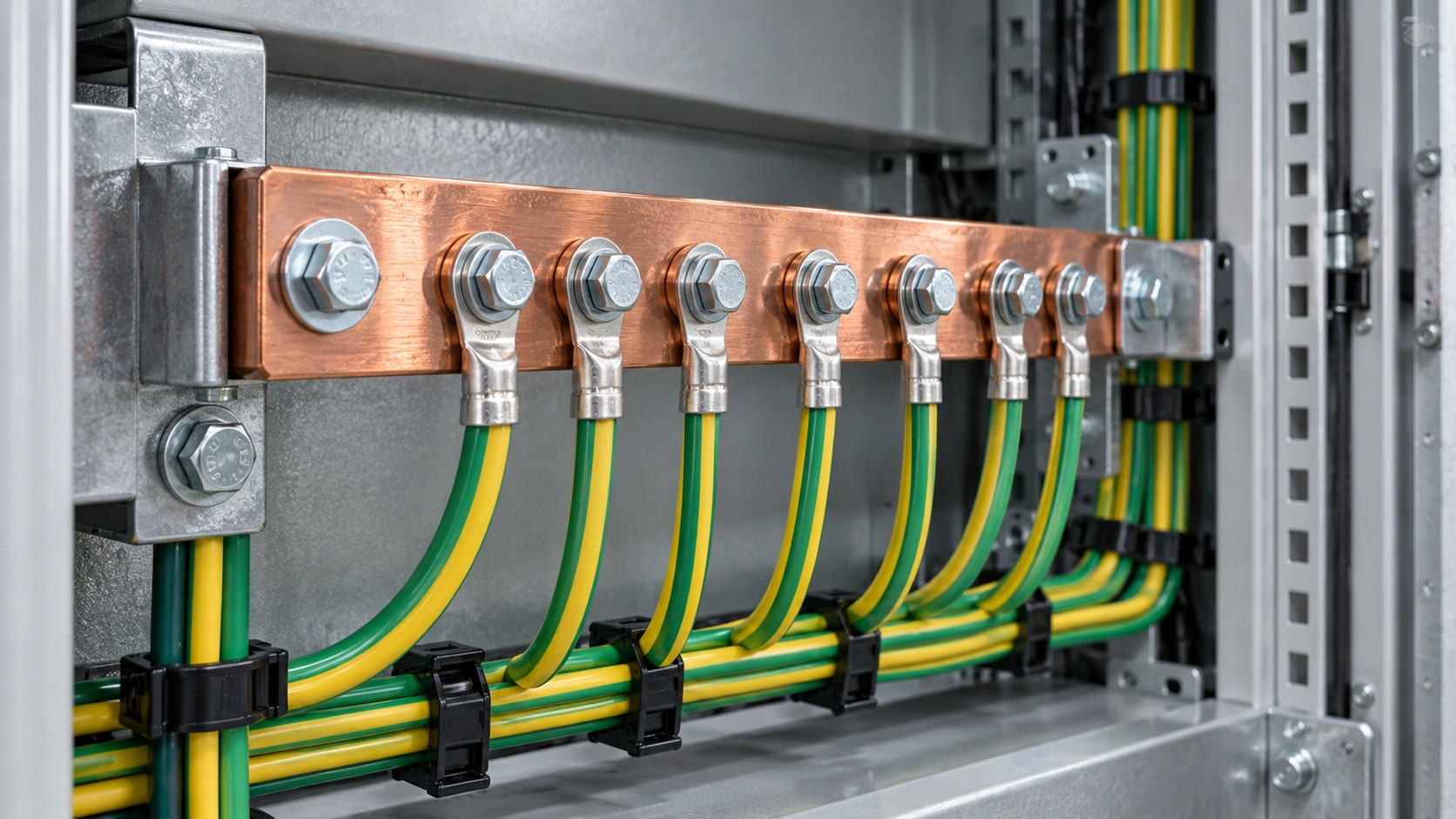
- Bonding: tray sections bonded for electrical continuity, verified by measurement, with earthing arranged per the installation standard.
Common mistakes
- Specifying “stainless” without the grade, and receiving 304 — which pits in a chloride sanitiser regime.
- Mixing 304 tray with 316 fixings or the reverse, creating a galvanic couple in the wet zone.
- Running galvanised or painted tray into the washdown area for the last few metres “because it was on site”.
- Mounting tray flush against the wall or soffit, so the back of the run can never be cleaned.
- Solid-bottom tray that pools rinse water, or covered sections without drainage.
- Cable entries into washdown enclosures without sealed, rated glands — the enclosure rating is lost at the entry point.
- Dividers and clamps bolted on with sharp-edged brackets that collect product residue.
Acceptance checkpoints
- Material certificates to EN 10204 type 3.1 showing the actual cast analysis (Cr, Ni, Mo, N, C) of the delivered stainless.
- Surface roughness report against the specified Ra value, on the delivered finish.
- Weld inspection: continuous welds, ground flush, no crevices at joints, dividers, and support brackets.
- Cleanability walkthrough with the hygiene or QA representative before handover, using the plant’s actual cleaning method.
- Drainage check: spray the run and confirm no standing water after the normal drain time.
- Enclosure ratings: IP test certificate (IEC 60529, and ISO 20653 / DIN 40050-9 for IP69) for the enclosed sections and glands.
- Continuity and earthing measurement recorded for the tray run.
Selection checklist
- Cleaning regime documented: chemicals, concentration, temperature, pressure, frequency.
- Material grade and PREN requirement set from the chloride and temperature exposure.
- Finish requirement (Ra value, electropolish or mechanical polish) stated in the purchase specification.
- Construction type: mesh, perforated, ladder, or covered — with a drainage decision.
- Stand-off clearance defined and compatible with the cleaning method.
- Load and span requirements per IEC 61537 or NEMA VE 1, with the declared support spacing.
- Separation of power and data circuits, and any EMC divider requirement.
- Enclosure IP/IK ratings for covered and junction sections, and matching cable glands.
- Fire performance and smoke classification where FRP is considered.
Quality inspection checkpoints
- Incoming material: verify the mill certificate against the ordered grade; spot-check with a portable alloy analyser on delivery.
- Fabrication: check weld quality and dressing; verify that cut edges are deburred and radiused.
- Finish: measure Ra on representative samples; verify no grinding marks run across the cleaning direction.
- Dimensional: check width, length, wire/perforation pattern, and the fit of couplings and accessories.
- Load test evidence: manufacturer’s declaration for the specified span and safety factor, per IEC 61537 or NEMA VE 1.
- Packaging: stainless must arrive protected from carbon-steel contamination (separate handling and storage from black steel).
How to evaluate a hygienic tray supplier
- Ask for the alloy and the certificate type (EN 10204 3.1 minimum), not a generic “stainless” description.
- Ask how welds are finished and whether the roughness is measured and reported.
- Ask for the declared working load and span, and which standard the figure is tested to.
- Ask for previous supply to food, beverage, or pharmaceutical plants — scope only, no client names required.
- Ask whether the range includes hygienic accessories: stand-off brackets, sealed covers, dividers, and drainable fittings.
- Ask how stainless is segregated from carbon steel in the workshop to avoid cross-contamination.
Frequently Asked Questions
1. Is 316L always required in a food plant?
Not everywhere. Dry packing and warehouse areas often work with 304L or galvanised steel. The 316L requirement comes from exposure to chloride-containing cleaners and sanitisers, warm humid conditions, and direct washdown. Define zones on the plant layout and specify material per zone.
2. What surface roughness should I specify?
Hygienic design guidance commonly uses Ra ≤ 0.8 µm in the product area, with electropolishing reaching roughly 0.3–0.6 µm. Confirm the value with the plant’s hygiene standard or QA function before ordering.
3. Can wire mesh tray carry power cables?
Yes for small and medium power cables, provided the declared load for the span is respected and cable support spacing limits sag. For heavy feeders, ladder or heavy-duty perforated tray is usually the better choice.
4. Does a cable tray get an IP rating?
Open tray does not — IP ratings per IEC 60529 apply to enclosures. Specify IP ratings for junction boxes, covered sections, and glands, and specify material, finish, and drainability for the open tray.
5. Why not use FRP instead of stainless?
FRP resists corrosion and is light, but check surface stability under repeated cleaning, fire and smoke classification, UV stability, and whether the resin system is acceptable for the zone. In high-care washdown areas 316L remains the common default.
6. How much clearance is needed behind the tray?
Enough for the cleaning method to reach all surfaces — commonly 50–100 mm from wall or soffit, more where a lance or brush must pass. Confirm with the hygiene representative.
7. Can I mix 304 and 316 components?
Avoid it in wet zones. Dissimilar metals in the presence of an electrolyte (detergent residue) form a galvanic couple, and the less noble alloy corrodes faster.
Specifying a Hygienic Tray Run?
BANGE Electric supplies stainless and other cable tray systems and can provide material certificates, finish requirements, and load declarations against IEC 61537 or NEMA VE 1. Send your cleaning regime, zone layout, cable schedule, and support spacing through the cable tray buyers guide or contact our engineering team.
Requirements may vary by application, market, and applicable standard.